Some gemstone combinations shout. Others simply glow. Morganite paired with diamond accents belongs firmly in the second group, which is a large part of why it has become such a quiet favorite in engagement ring design. The stone brings a warm, blush-toned softness, while diamonds bring clear, colorless light. Put them together and you get a ring that feels romantic without ever tipping into flashy. This is an explainer for anyone curious about why the two stones flatter each other so naturally, and how thoughtful design choices shape the final effect.
Peach color against colorless brilliance
Morganite is a member of the beryl family, the same family that gives us emerald and aquamarine. Its signature is a gentle peach-to-pink hue that reads as soft and almost lit from within. Diamonds, by contrast, are prized for being colorless and for the way they scatter white light. When you set these two next to each other, the contrast does something lovely: the diamonds make the morganite’s warmth look richer, and the morganite makes the diamonds look brighter by comparison. It is a relationship built on difference rather than sameness. Understanding how morganite and diamond compare in color, hardness, and light behavior helps explain why designers reach for the pairing so often. Neither stone competes with the other; each one highlights what the other lacks.
How accent diamonds frame morganite
Accent diamonds are the small stones placed around or alongside a center gem, and their job is to frame rather than steal attention. Around a morganite, they act a bit like a bright border on a soft watercolor. The colorless sparkle draws the eye inward toward the peach center, giving it a focal point and a sense of importance. Because morganite is naturally understated in tone, a ring of tiny diamonds keeps it from looking flat or washed out in certain lighting. The framing effect is subtle but powerful. It is the difference between a stone that sits quietly on the hand and one that feels deliberately, elegantly presented.
Halo, three-stone, and accented-band logic
There are a few classic ways to combine morganite with diamond accents, and each creates a different mood. A halo wraps a continuous ring of small diamonds around the center stone, which visually enlarges the morganite and maximizes overall sparkle. A three-stone design places a diamond on either side of the center, a layout often read as symbolic of a shared past, present, and future. An accented band scatters diamonds along the shank itself, leaving the center stone to stand more independently while still catching light down the sides. None of these is objectively better than the others. They simply answer different questions about how much brilliance you want and where you want the eye to travel.
Keeping the balance soft rather than flashy
The whole appeal of a morganite center is its softness, so the accent work should support that quality rather than fight it. The most common misstep is overloading a delicate peach stone with so many diamonds that the warmth gets lost in a sea of white sparkle. Restraint tends to win here. A few well-placed accents, or a single tidy halo, usually reads as more graceful than an aggressively encrusted setting. Proportion matters too: the accent stones should feel scaled to the center, never large enough to rival it. When the balance is right, the diamonds whisper support to the morganite instead of talking over it, and the result is the gentle glow the pairing is loved for.
A few simple principles help keep that balance intact:
- Let the morganite remain the largest and most saturated element on the ring.
- Choose accent sizes that complement, rather than crowd, the center stone.
- Favor clean, even settings so the peach tone stays visible from every angle.
- Remember that a little sparkle goes a long way against a soft-colored gem.
Brightness and light
Light is the quiet engine behind everything a morganite-and-diamond ring does. Morganite has good clarity and transparency, so it allows light to pass through and return with a soft, rosy warmth. Diamonds handle light differently, bending and splitting it into that familiar white fire. A well-designed pairing uses both behaviors at once, so the ring shifts subtly as the hand moves through a room. In softer, warmer light the morganite tends to deepen and look more peach. Under cooler or brighter light the diamond accents come forward and add crispness. This gentle interplay is why the combination never looks static; it feels alive across a normal day. Good design considers how a morganite and diamond engagement ring will read in everyday light, not only under a jeweler’s lamp, so the everyday version of the ring is the one that truly matters. You can see the range of these designs in the morganite and diamond engagement ring selection, where the same core idea appears in many arrangements.
When a solitaire morganite stands alone
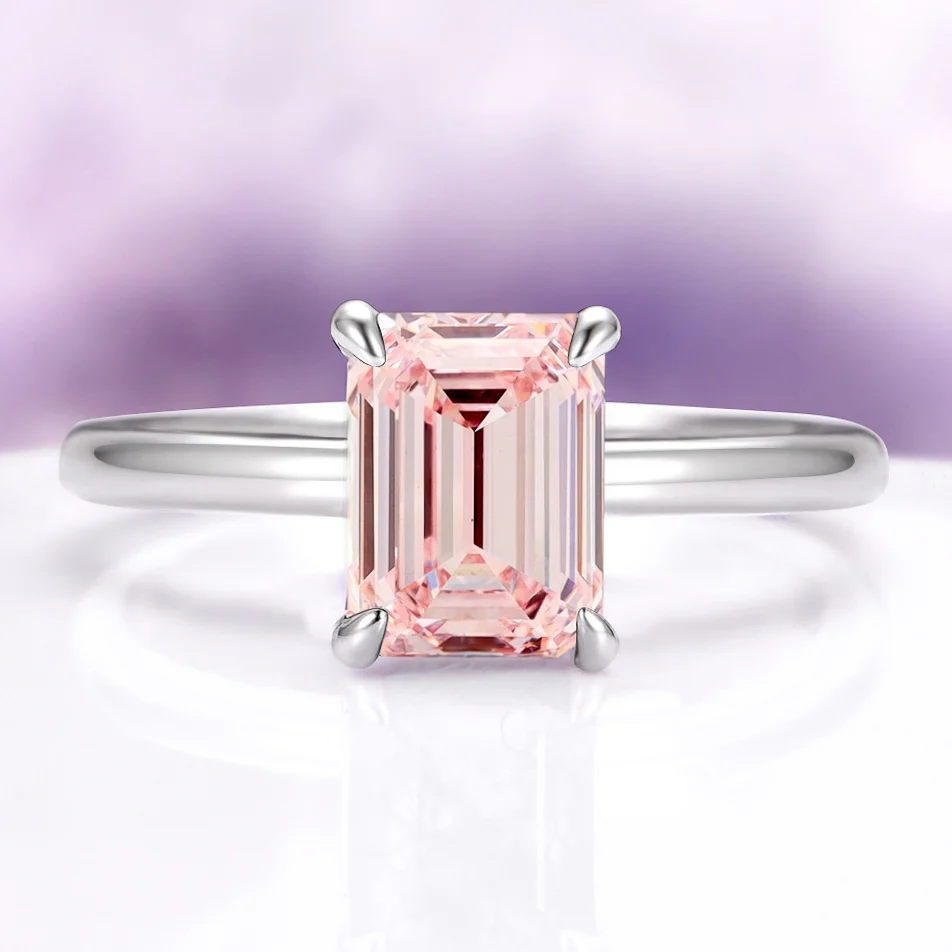
Not every morganite needs diamond company. A solitaire setting, where the center stone sits on a clean band with no accents, is a valid and beautiful choice that lets the peach color speak entirely on its own terms. This approach suits people who love minimalism, or who want the stone’s natural tone front and center without any competing sparkle. The trade-off is straightforward: you lose the framing brightness that accents provide, but you gain a purer, more understated statement. A solitaire also tends to feel timeless and easy to pair with other pieces later. Whether to add diamonds ultimately comes down to personality. Some hands want the extra shimmer; others want the calm of a single, glowing stone. Both are entirely correct.
The takeaway
Morganite and diamond accents work together because they are opposites that happen to flatter each other. Warm meets cool, soft meets bright, understated meets brilliant. Whether you lean toward a halo, a three-stone layout, an accented band, or a clean solitaire, the guiding idea stays the same: let the morganite’s gentle color lead, and let the diamonds serve it. Get that hierarchy right and you end up with a ring that captures exactly the mood the pairing is famous for, which is soft, romantic sparkle that feels effortless rather than loud.

James Martin is a passionate writer and the founder of OnTimeMagazines & EastLifePro. He loves to write principally about technology trends. He loves to share his opinion on what’s happening in tech around the world.